A Glossary of Smoky Mountain Terms Visitors Always Ask About
Published Sep 27, 2026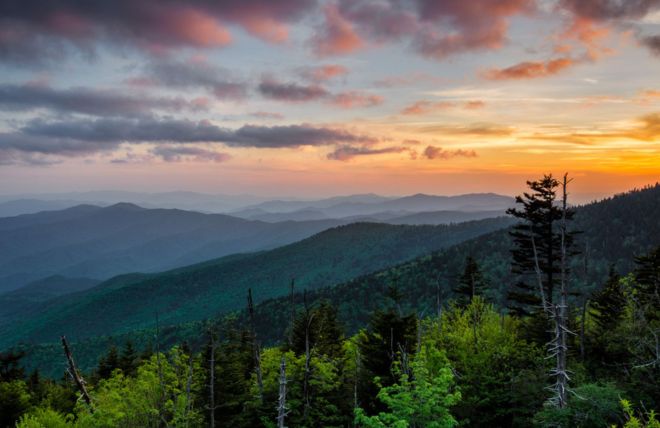
Spend any time planning a Smoky Mountain trip and you'll run into words that leave you guessing — What's a "cove"? Why is that peak called Kuwohi now? Is a "holler" a real place? The Smokies have a vocabulary all their own, drawn from Cherokee language, Appalachian settler speech, and the landscape itself. Here's a plain-English glossary of the terms visitors ask about most, so you'll know exactly what you're looking at.
The name itself
Smoky Mountains / the Smokies
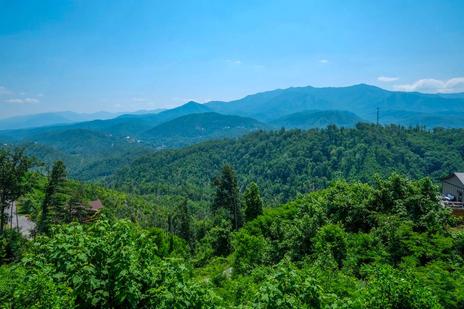
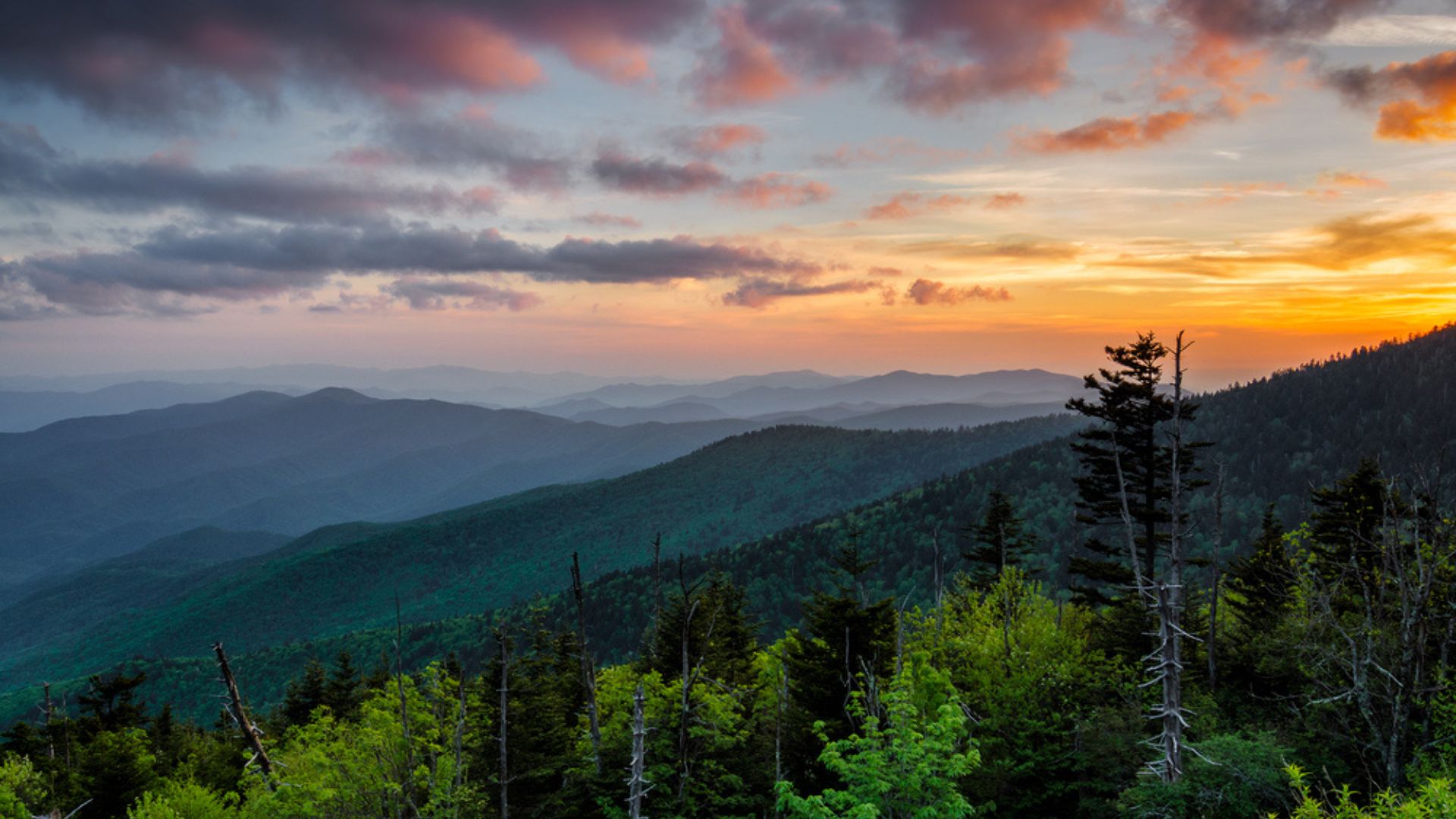
The "smoke" isn't smoke at all — it's a natural blue-tinged fog. The region's abundant plant life releases volatile organic compounds (VOCs) that react in the air to form tiny particles, which scatter blue light and create the signature hazy, smoky appearance draped over the ridges. The Cherokee called the area Shaconage (Sha-Kon-O-Hey), meaning "place of blue smoke," and European settlers drew on that name for both the Great Smoky Mountains and the nearby Blue Ridge Mountains, whose haze comes from the same phenomenon. So a more literal name might be the "Foggy Mountains" — but "Smoky" stuck. Read more in our post on surprising facts about the area.
Great Smoky Mountains National Park
The most visited national park in the United States, straddling the Tennessee–North Carolina border. Locals shorten it to "the Smokies," "the Great Smokies," or just "the park." It has no entrance fee (though a parking tag is required for stops over 15 minutes).
Place names that trip people up
Kuwohi
koo-WOH-hee
The highest peak in the park (6,643 feet) and the third-highest east of the Mississippi. Long known as Clingmans Dome, the mountain had its Cherokee name — Kuwohi, meaning roughly "mulberry place" — officially restored in 2024. It's a sacred site to the Cherokee. You'll still see both names in older signage and maps.
Gatlinburg (not "Gatlinberg")
The mountain town at the park's main Tennessee entrance — spelled with a "u," not an "e." It's one of the most common misspellings in Southern tourism. See our full post on the correct spelling and its origin.
Cades Cove
The park's most popular destination — a broad, open valley ringed by mountains, circled by an 11-mile one-way loop road, famous for wildlife and preserved pioneer homesteads. Locals often just call it "the Cove."
Qualla Boundary
The homeland of the Eastern Band of Cherokee Indians, centered on the town of Cherokee, North Carolina, at the park's southern entrance. Notably, it's land the Cherokee bought back and hold in trust — not a typical federally assigned reservation. See our guide to the Cherokee homeland.
The Spur
The scenic stretch of US-441 connecting Pigeon Forge and Gatlinburg, running alongside the Little Pigeon River through a sliver of national park land. When locals say "take the Spur," they mean this connector road between the two towns.
Appalachian landscape words
Much of the Smokies' vocabulary describes the land itself — terms early Scots-Irish and English settlers used that are still on the maps today.
Cove
A flat, open valley nestled among the mountains — like Cades Cove. Not a coastal term here; in Appalachia a cove is a sheltered lowland surrounded by higher ridges, often historically used for farming.
Bald
A mountaintop or high ridge covered in grass or shrubs rather than forest, even though it's below the tree line where trees "should" grow. Andrews Bald and Gregory Bald in the park are famous examples — Gregory Bald for its flame azaleas.
Gap
A low point or pass in a mountain ridge — the natural place a road or trail crosses over. Newfound Gap, the main pass over the crest of the park on US-441, is the best-known.
Holler (hollow)
A small, narrow valley between hills or mountains, usually with a creek running through it. "Holler" is simply the Appalachian pronunciation of "hollow," and it appears both as everyday speech and in place names.
Branch, prong, and fork
All words for flowing water. A branch is a small stream or creek; a prong and a fork are larger tributaries where waters divide or join — as in the West Prong of the Little Pigeon River. You'll see all three across park maps.
Knob
A prominent rounded hill or small mountain peak. It shows up in names throughout the region (like Waterrock Knob on the Blue Ridge Parkway).
Nature terms you'll hear
Synchronous fireflies
A rare species of firefly (found in only a few places on Earth) whose males flash in unison during a brief early-summer mating window, most famously at Elkmont in the park. Viewing is so popular it runs on a lottery system. It's one of the Smokies' most magical natural events.
Rhododendron "hell"
An old settler term for a dense, nearly impenetrable thicket of rhododendron or laurel — so thick it was said you could get lost or "catch hell" trying to bushwhack through it. The park's rhododendron blooms (early summer) are a major draw.
Old-growth forest
Forest that has never been logged. The Smokies protect one of the largest tracts of old-growth forest in the eastern U.S. — towering, centuries-old trees you can still walk among on certain trails.
The elk
Reintroduced to the park in the early 2000s after being absent for over a century, elk now graze most reliably in the fields around the Oconaluftee Visitor Center and Cataloochee on the North Carolina side. The fall "rut" (mating season) is the dramatic time to see them.
Local words for getting around
The Parkway / the Strip
The main drag through both Gatlinburg and Pigeon Forge is officially the Parkway; Gatlinburg's is often called "the Strip." When someone says they're "on the Parkway," context (and traffic) tells you which town.
Gondola vs. chairlift vs. tramway
Visitors mix these up constantly. A chairlift is an open-air seat (like the Gatlinburg SkyLift). A gondola is an enclosed cabin — Anakeesta's Crystal Express is an all-glass gondola. A tramway (aerial tram) is a larger enclosed cabin holding many riders at once, like the Ober Gatlinburg tram from downtown up the mountain.
Trolley
The affordable public shuttle systems in Gatlinburg and Pigeon Forge — a cheap, easy way to get around and skip the parking hassle on the Parkway.
Frequently asked questions
Why are the Smoky Mountains called "smoky"?
The "smoke" is actually a natural blue-tinged fog. Plants in the region release volatile organic compounds that form tiny particles in the air, scattering blue light and creating the hazy, smoky look over the ridges. The Cherokee called the area Shaconage — "place of blue smoke" — and settlers adapted that into "Smoky Mountains."
What is a "cove" in the Smoky Mountains?
A cove is a flat, open valley surrounded by higher mountains — like Cades Cove. In Appalachia it's a land term, not a coastal one: a sheltered lowland historically used for farming, ringed by ridges.
Why is Clingmans Dome now called Kuwohi?
In 2024, the peak's Cherokee name, Kuwohi (koo-WOH-hee, roughly "mulberry place"), was officially restored, recognizing its significance as a sacred Cherokee site. It's the highest point in the park at 6,643 feet. You may still see the old name Clingmans Dome on some maps and signs.
What's the difference between a gondola, chairlift, and tramway?
A chairlift is an open-air seat (like the Gatlinburg SkyLift); a gondola is a small enclosed cabin (like Anakeesta's Crystal Express); and an aerial tramway is a larger enclosed cabin carrying many riders at once (like the Ober Gatlinburg tram). All three carry you up the mountains, just in different styles.
What does "holler" mean?
It's the Appalachian pronunciation of "hollow" — a small, narrow valley between hills, usually with a creek running through it. You'll hear it in everyday speech and see it in local place names.
Now that you speak a little Smoky Mountain, come see it for yourself. Browse Colonial Properties' cabins across Gatlinburg, Pigeon Forge, and the Smokies — coves, hollers, and mountain views included.