Driving Newfound Gap Road End to End: A Stop-by-Stop Guide
Published Oct 27, 2026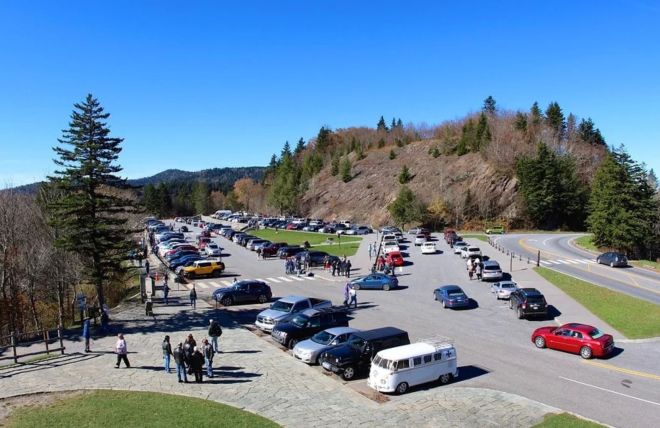
If you only have time for one drive in the Smokies, make it Newfound Gap Road. The route climbs from Gatlinburg clear over the crest of the mountains and down into Cherokee, North Carolina, gaining thousands of feet and crossing from one state's forests into another's along the way. It's the only road that cuts all the way through the heart of the park, and end to end it packs in overlooks, a historic mountaintop landmark, a spur to the highest point in the Smokies, and a good chance at elk. Here's how to drive it stop by stop.
The road runs roughly thirty miles between the two visitor centers and takes about an hour nonstop — but nonstop misses the point. Give it half a day with stops, or a full day if you add the side trips, and plan it as a one-way journey across the park rather than a loop.
Start: Sugarlands Visitor Center
Begin just outside Gatlinburg at Sugarlands, the park's main Tennessee-side visitor center and the natural place to orient yourself — exhibits, maps, restrooms, and rangers who can tell you what's blooming or what wildlife is active. Fill your water and your tank here; there's no fuel inside the park. From Sugarlands the road starts its long, steady climb into the mountains.
The climb and the overlooks
As the road ascends, it threads a series of pull-offs and overlooks that are the real reward of the drive. The valley drops away behind you, ridgelines stack up blue into the distance, and the forest changes as you gain elevation — the hardwoods of the lower slopes giving way to spruce and fir near the top, the same trees you'd find far to the north. Stop often; the views are different at every level, and the overlooks on the way up are some of the most photographed in the park. Early morning light and the fog that gives the mountains their name are both at their best up here.
Newfound Gap and the Rockefeller Memorial
The high point of the drive, literally, is Newfound Gap — the lowest drivable pass over the crest, and the spot where you cross the Tennessee–North Carolina state line. The large parking area here is the centerpiece of the trip. It's home to the Rockefeller Memorial, the stone terrace where the park was formally dedicated, and the Appalachian Trail crosses the road at this very point, so you can step onto the famous footpath for a few yards even if you never hike another mile of it. On a clear day the views from the gap stretch for miles; it's also noticeably cooler and windier than the valley, so bring a layer even in summer.
Side trip: the road to Kuwohi (Clingmans Dome)
Just south of Newfound Gap, a side road branches off and climbs to Kuwohi — the peak long known as Clingmans Dome and restored to its Cherokee name in 2024. It's the highest point in the Smokies, and a short, steep paved walk from the parking area leads to a spiral observation tower with a panorama over the whole range. It's a worthy detour if the spur road is open and the weather's clear; when clouds are sitting on the ridge, you'll see nothing but mist, so save it for a good day. The access road here is seasonal and closes in winter, so it's another one to check before you commit the time.
The descent into North Carolina
From the gap the road winds down the North Carolina side, and the character shifts — the descent follows rushing streams, passes more overlooks, and feels wilder and less traveled than the Tennessee approach. Take your time; the downhill side has its own set of pull-offs worth stopping for, and the drive is as scenic going down as coming up.
End: Oconaluftee and the elk
The road ends near Cherokee at the Oconaluftee Visitor Center and the Mountain Farm Museum, a collection of historic log buildings that show what mountain life looked like a century ago. The real draw here, though, is the elk. The fields around Oconaluftee are the park's best-known spot to see the reintroduced herd, especially in early morning and at dusk. Keep a safe, legal distance and stay in or near your car if they're close — they're large wild animals, not a petting zoo. It's a fitting finish to a drive that starts in a tourist town and ends with elk grazing in an open bottomland.
Tips for the drive
Go one way, plan the return — it's a through-route, not a loop. Either backtrack over the gap or build a longer day looping back through the surrounding area.
Fuel and water before you enter — there are no gas stations or shops inside the park.
Dress for the top — Newfound Gap and Kuwohi run much cooler than the valley floor, any time of year.
Start early — for light, for parking at the popular stops, and for the best shot at elk and wildlife.
Mind the parking tag — the park requires a paid parking tag to stop and park; have one before you plan a day of hopping between overlooks.
Frequently asked questions
How long does it take to drive Newfound Gap Road?
About an hour nonstop across its roughly thirty miles, but plan on half a day with overlook stops, or a full day if you add the Kuwohi spur and time at both ends. It's a one-way route through the park, not a loop.
Where does Newfound Gap Road start and end?
It runs between Sugarlands Visitor Center near Gatlinburg, Tennessee, and the Oconaluftee Visitor Center near Cherokee, North Carolina, crossing the state line at Newfound Gap at the top.
Is Newfound Gap Road always open?
No. It closes periodically for winter weather, high winds, and occasional roadwork, sometimes on short notice, and the Kuwohi (Clingmans Dome) spur road is seasonal and closed in winter. Always check current road status on the national park's website before you go.
Can I see elk along the drive?
Yes — the fields around the Oconaluftee Visitor Center near Cherokee are the park's best-known elk-viewing spot, best at dawn and dusk. Keep a safe, legal distance; they're large wild animals.
Do I need a parking pass?
The park requires a paid parking tag to stop and park, though there's no entrance fee to drive through. Pick one up before a day of stopping at the overlooks.
Newfound Gap Road is the drive that shows you the whole park in an afternoon, and staying close to the Tennessee entrance means you can be at Sugarlands and climbing before the overlooks fill up. Find a Smoky Mountain cabin near the park, and pair this drive with our guides to the area's best scenic drives and seeing elk in Cherokee.