The Smoky Mountains: Uncovering the Origin of Its Name
Published Feb 9, 2023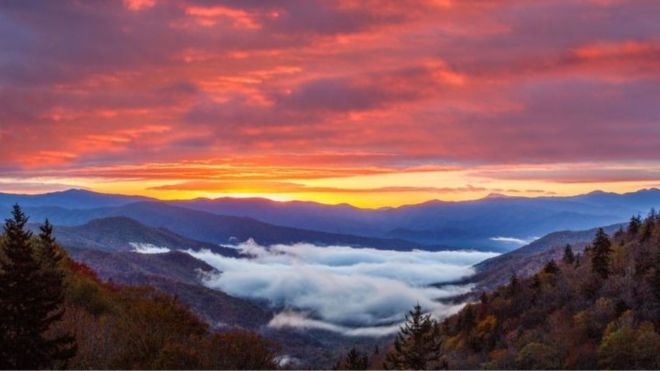
The name "Smoky Mountains" is older than the United States — it came from the Cherokee, was adopted by European explorers, and describes a real atmospheric phenomenon that still shrouds the ridges today. Here's where the name actually came from.
What causes the "smoke"
The haze that gives the Great Smoky Mountains their name is real and has a specific scientific cause. The mountains' dense forests — primarily deciduous hardwoods, conifers, and rhododendron — release enormous quantities of volatile organic compounds (VOCs), particularly isoprene and terpenes, into the atmosphere as a byproduct of photosynthesis. These compounds react with oxygen and sunlight to form fine aerosol particles that scatter blue light and create the characteristic blue-gray haze visible across the ridgelines.
The effect is most pronounced in summer when warm temperatures accelerate photosynthesis and VOC production, and most visible from elevated viewpoints looking across multiple ridges — the layering of haze deepens with distance. The Appalachian Mountains have produced this haze for hundreds of millions of years, long before any human named them. The Smokies' combination of high biodiversity, warm humid climate, and complex topography makes the phenomenon more visible here than almost anywhere else in the eastern United States.
The Cherokee name: Shaconage
The Cherokee people, who inhabited these mountains for thousands of years before European contact, called them Shaconage — commonly translated as "place of the blue smoke." The name reflects exactly what the Cherokee saw and experienced: mountains that were perpetually wrapped in a haze that resembled smoke rising from fires. In Cherokee tradition, the mountains were sacred, and some accounts attribute the smoke to the fires of the Thunder God who was said to dwell on the highest peaks. The name Shaconage predates any European presence in the region by centuries, making the Cherokee the first to document and name what we still observe today.
How European explorers inherited the name
When Spanish explorers led by Hernando de Soto entered the southern Appalachians in the 16th century, and when British and Scots-Irish settlers pushed into the mountain frontier in the 17th and 18th centuries, they encountered both the Cherokee's description and the phenomenon itself. The English translation of Shaconage — "smoky mountains" — was a natural and accurate rendering of what the name described. European cartographers began using "Smoky Mountains" on maps in the colonial era, and the name solidified through common usage among settlers, trappers, and traders who moved through the region.
The mountains' name is one of the more direct examples of indigenous nomenclature surviving intact into modern American geography — the European settlers didn't rename the mountains so much as translate the name that was already there.
The geological story behind the mountains themselves
The Smoky Mountains are among the oldest mountain ranges on Earth — formed roughly 300 million years ago during the collision of the North American and African tectonic plates that created the Appalachian chain. What we see today are the heavily eroded remnants of what were once peaks as tall as the Himalayas. The resistant metamorphic and igneous rocks of the Smokies — primarily gneiss, schist, and quartzite — have weathered more slowly than the surrounding softer formations, leaving the current ridgeline standing above the valleys. The biological diversity of the Smokies — over 19,000 documented species — is partly a function of their age: these mountains served as refugia for plant and animal species during ice ages, preserving diversity that was lost elsewhere.
How the national park came to protect it
The movement to establish a national park in the southern Appalachians began in earnest in the 1920s, driven by concerns about the rapid logging of the old-growth forests and the loss of the mountain communities and natural heritage they supported. Unlike western national parks carved from federal land, the Smoky Mountains required purchasing or donating privately held land — a process that took years and involved contributions from the state governments of Tennessee and North Carolina, the Rockefeller family, and thousands of private donors. Great Smoky Mountains National Park was established in 1934, with full development completed by 1940. The park's no-entrance-fee policy — a condition of the original Tennessee land deed — has been in place ever since, making it both the most accessible and the most visited national park in the country.
Frequently asked questions
Is the haze in the Smoky Mountains pollution or natural?
The baseline haze is natural — caused by VOC emissions from the forests, which have produced this effect for hundreds of millions of years. However, air pollution from industrial emissions and vehicle exhaust has added to the regional haze since the 20th century, reducing visibility in the park compared to historical levels. The EPA and NPS have monitored air quality in the Smokies for decades; visibility has improved since the Clean Air Act's acid rain provisions took effect, but the park still experiences pollution-related haze above the natural baseline on some days.
What does Shaconage mean?
"Shaconage" (sometimes spelled "Sha-con-age") is a Cherokee word commonly translated as "place of the blue smoke." It refers to the characteristic blue-gray haze that the Cherokee observed rising from the mountain ridges — the same VOC-produced atmospheric effect that gives the mountains their English name. The Cherokee name and the English name are essentially translations of the same observation.
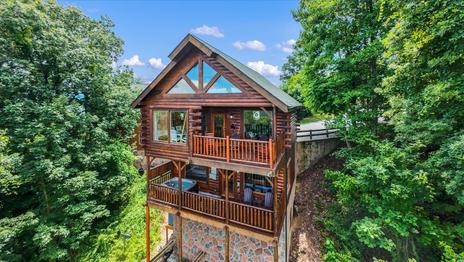
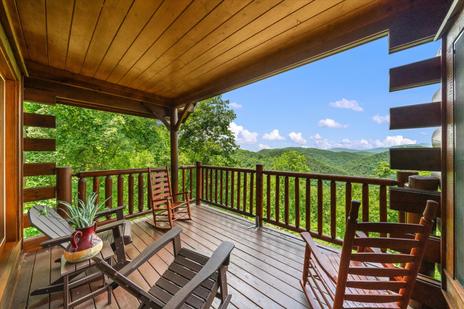
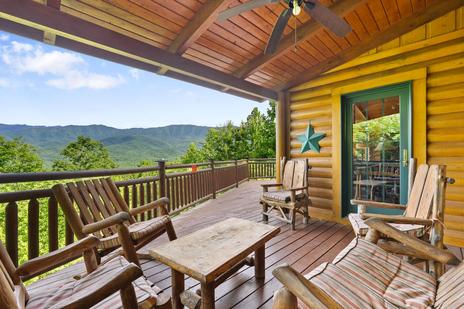
Experience the mountains the name describes — from a Gatlinburg cabin rental with mountain views, close to every ridge and overlook in the park.