Fact or Fiction: Smoky Mountain Myths
Published Nov 19, 2023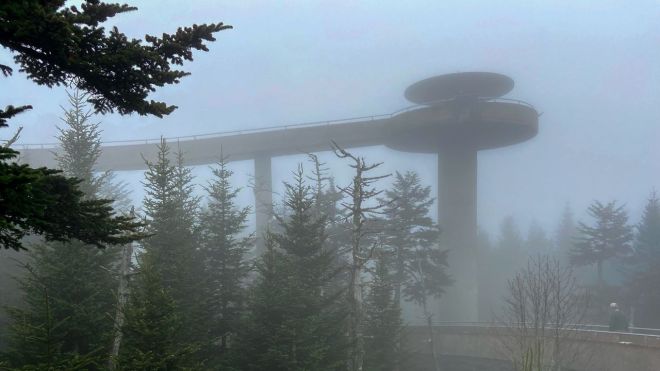
The Great Smoky Mountains come with a full complement of myths — some flattering, some cautionary, some just wrong. Here are eight of the most common misconceptions about the Smokies, with the actual facts behind each one.
Myth 1: The Smoky Mountains are named for smoke
FictionThe name has nothing to do with fire. The blue-gray haze that gives the Smokies their characteristic appearance is produced by the vegetation itself — the dense forest canopy releases enormous quantities of volatile organic compounds (primarily isoprene from tree leaves) into the air. These compounds interact with moisture and sunlight to form the fine aerosol particles that scatter light and create the layered, smoky appearance visible across the ridgelines. The effect is most pronounced in warm, humid weather when vegetation is actively photosynthesizing — which is why the haze is densest in summer and lightest in winter when the deciduous trees are bare. The name describes this phenomenon accurately, just not the cause most people assume.
Myth 2: Wild panthers still roam the Smoky Mountains
FictionThe Eastern Cougar — also called mountain lion, panther, or catamount depending on region — was officially declared extinct by the U.S. Fish & Wildlife Service in 2011. The last confirmed sighting in the Smoky Mountains region dates to the early 20th century. Periodic reports of large cat sightings in the park continue to circulate, but wildlife biologists consistently attribute these to misidentification — typically bobcats (which are present in the park), large domestic cats, or dogs. The Smokies have no confirmed wild cougar population. The only large predators confirmed in the park are black bears and coyotes.
Myth 3: The national park was created without controversy
FictionThe establishment of Great Smoky Mountains National Park involved one of the most contentious land acquisition processes in national park history. Unlike western parks carved from federal land, the Smokies required purchasing — and in many cases forcibly taking — privately held land that had been farmed and settled for generations. Approximately 1,200 families were displaced from the land that became the park, many of them descendants of Scots-Irish settlers who had lived in the region since the 18th century. The state of North Carolina and Tennessee used eminent domain extensively; the federal government provided funding through a combination of state appropriations and a donation from John D. Rockefeller Jr. The Cherokee people had already been removed from the area in the 1830s during the Trail of Tears. The communities of Elkmont, Proctor, Cades Cove, and Cataloochee were all absorbed into the park, their residents relocated. The park was formally established in 1934 — but the human cost of its creation remained a contested part of its history.
Myth 4: Kuwohi (Clingmans Dome) is the tallest mountain in the eastern United States
FictionKuwohi, known as Clingmans Dome, is the highest point in Great Smoky Mountains National Park and the highest point in Tennessee at 6,643 feet. But the tallest mountain in the eastern United States is Mount Mitchell in the Black Mountains of North Carolina, at 6,684 feet — also in the Appalachian range, 41 feet higher than Kuwohi. Both peaks are within the same broader mountain system, and both offer remarkable summit experiences. Kuwohi's half-mile paved trail to the observation tower makes it the more accessible of the two; Mount Mitchell is accessible by car with a short walk to the summit. The distinction matters mainly if you're keeping a list of high points — both are genuinely impressive Appalachian summits.
Myth 5: The Smoky Mountains got their name recently
Fact — mostlyThis one is more nuanced than a simple true or false. The mountains themselves are ancient — geologists estimate the Appalachians formed between 300 and 480 million years ago, making them among the oldest mountain ranges on the planet. The Cherokee people, who inhabited the region for thousands of years before European contact, called them "Shaconage" — typically translated as "land of blue smoke" — which reflects the same haze-driven phenomenon that produced the English name. The translation "Smoky Mountains" entered common use as European settlers and American explorers documented the region in the 18th and early 19th centuries. So the phenomenon the name describes is ancient; the English name is a few hundred years old at most.
Myth 6: You can't see black bears in winter
FictionBlack bears in the Smokies enter a state of torpor in winter rather than true hibernation — their body temperature drops only slightly, and they can rouse and become active during warm spells. Pregnant females are the most consistently denned through winter; males and non-pregnant females may remain active through much of the season if food sources are available. Winter is actually one of the best times to spot bears in the park because the bare trees open sightlines that summer's canopy blocks entirely. Cades Cove, in particular, has produced bear sightings in January and February when the meadow is free of summer vegetation. The assumption that bears disappear completely in winter leads visitors to drop their guard — don't.
Myth 7: Great Smoky Mountains National Park charges an entrance fee
FictionGreat Smoky Mountains National Park is one of the only major national parks in the United States that charges no admission. No entrance fee, no annual pass required, no timed-entry ticket for most areas. The park is entirely free to enter, which is a significant part of why it consistently draws more visitors than any other national park in the country. Some specific facilities within the park — the Clingmans Dome Road, certain campground sites, and a recently implemented parking reservation system at popular trailheads — have associated costs, but entering the park itself is free. This has been true since the park's establishment and reflects a founding condition tied to how the land was donated to the federal government.
Myth 8: The fog in the Smoky Mountains is pollution
FictionThe haze is primarily natural — produced by biogenic volatile organic compounds released by the forest, as described in Myth 1. That said, regional air pollution has historically worsened the haze's density and reduced visibility in the park. Acid rain from coal-fired power plants in the Ohio Valley significantly damaged high-elevation vegetation through the 1970s and 1980s. Clean Air Act regulations and emissions reductions over the past three decades have measurably improved visibility in the Smokies — visibility at the highest elevations is now better than it was in 1990, though still below the historical baseline from before industrial pollution. The natural haze and the pollution component are real and distinct; the fog you see on a summer morning is overwhelmingly natural in origin.
Frequently asked questions
What is the haze in the Smoky Mountains made of?
The characteristic blue-gray haze is primarily composed of fine aerosol particles formed when volatile organic compounds — mainly isoprene — released by the forest's vegetation react with moisture and sunlight. The particles scatter shorter wavelengths of light (blues and violets) more than longer wavelengths (reds and oranges), which produces the blue-tinged appearance of the haze at distance. The effect is strongest in summer when vegetation is most actively photosynthesizing. Regional air pollution has historically added to the haze's density, but natural biogenic emissions are the primary cause.
Is Great Smoky Mountains National Park really free?
Yes — there is no entrance fee to enter the park. Some specific services within the park have costs: certain campground reservations, the timed-entry parking pass system at popular summer trailheads (available through recreation.gov), and the Clingmans Dome Road access fee. But the park itself charges no admission, a policy that has been in place since its establishment in 1934.
Browse Smoky Mountain cabin rentals — your base for exploring the park, the history, and the haze.